
Chapter 19
In Chapter nineteen, Grace and Glory (Much-Afraid) and her companions spend several weeks in the High Places learning from the King. We learn that they are in the lowest level of the High Places, and there are greater heights that can only be accessed by those who have “finished their pilgrim life on earth” (pg. 117). In this chapter the Good Shepherd asks Grace and Glory (Much-Afraid) if she understands now how he was able to make her feet like hinds’ feet on the High Places. She thinks back through her journey and responds with the four lessons she learned on her journey.
The first lesson she shares is that she must accept with joy everything that the Good Shepherd allowed to happen and everything the path led her to. She realized that she was never meant to avoid the hard things, but instead to surrender her will to the Good Shepherd in the midst of the hard things. She learned that when things don’t go how she wants them to she can look up at the Good Shepherd and say she is willing to accept her situation with joy.
For this to really make sense to us, we need to look at how we define joy. Joy is not the same as being happy and we do not need to fake being happy when we go through hard things. Joy is only experienced relationally. As Geoff Holsclaw explains, “Joy is a relational experience of sharing gladness to be with another person. When you are with someone who wants to be with you it brings joy” (pg. 20, Landscapes of the Soul). The Good Shepherd is not expecting Grace and Glory (Much- Afraid) to find joy in her circumstance, he is expecting her to find joy in Him being with her in her circumstance. In other words, “Be still and know that I am God” Psalm 46:10
This is also a distress tolerance skill known as radical acceptance. This DBT skill is taught in therapy to help clients learn how to accept the parts of their reality that cannot be changed and is not in their control. The purpose of this skill is to prevent pain from turning into suffering, which it does when we try to control something we cannot control and we get lost in the questions of “Why did this have to happen?” When we surrender our “whys” and our desire to control the outcome to Jesus, when we follow through with being still and knowing that he is God, we are able to experience his presence with us, and it gives us joy.
I am going to talk about the second and fourth lesson Grace and Glory (Much-Afraid) learned together, because they are so connected. The second lesson she learned is that she needs to bear with love what others do to harm her and forgive them so that evil can be overcome with good. The fourth lesson she learned was that every circumstance can be transformed by the power of love and forgiveness and obedience to the Good Shepherd’s will. These two together have taught her that love, obedience and forgiveness can transform even the hardest situation by overcoming the bad with good. As Proverbs 10:12 explains, “Hatred stirs up strife, but love covers all offenses”.
Once again, this is not meant to be done on our own, and it is not even possible in our own strength. This is only possible because of the new life we have in Jesus Christ. Love is as much a part of who Christ is as his forgiveness is, and this is important for us to realize that learning to love like Christ also means learning to forgive like Christ.
In Ephesians 4:17-32 we are given a summary of what it means to live in the new life that we have in Christ. We are told that we must not be like the gentiles who are alienated from God because of their hardness of heart (vs 17-19). We are reminded that life in Christ means putting off our old self and putting on the “new self, created after the likeness of God” (vs. 24). We are instructed to speak truth (vs 35) and to be angry but to not sin in our anger and deal with that anger before we go to bed (vs 26). We are told to not give the devil any opportunities (vs 27) and instructed to not allow thieves to keep stealing but to guide them to do honest work (vs 28). We are told to not speak anything that could corrupt our relationships, but only speak what will build up those around us (vs 29). We are instructed not to grieve the Holy Spirit (vs 30) and to remove from ourselves any anger, bitterness, wrath, slander or malice (vs 31). Then finally, to be kind and tender hearted to each other, forgiving others as God has forgiven us (vs 32). All of these verses point to what it means to live a life of love and forgiveness, to live a life modelled after Christ. A life of love and forgiveness is not learned overnight, it is taught to us as we grow closer to Christ and experience his love and forgiveness more in our own life. His love and forgiveness helps our hearts to be less hardened and more tender, eventually to the point that we can’t help but see others the way Christ sees them.
If forgiving others for the harm they have done to you is hard to imagine, don’t be discouraged. Jesus is not expecting you to be able to this on your own, and he knows how to help you get there. What you need to focus on is drawing close to him, asking him to help you love and forgive like he does, and stay focused on Him.
Speaking of the love Christ gives us, the third lesson Grace and Glory (Much-Afraid) learned is that the Good Shepherd never saw her as she was but always viewed her as she would be. She says that he treated her with love worthy of a Queen, even when she was still lame and disfigured. She only understood his love for her after reaching a stage in her journey where she could accept it, realizing that it had always been present—even when she doubted her worthiness.
At the end of chapter nineteen, the Good Shepherd tells Grace and Glory and Jay and Peace to follow him because he wants to show them another part of the mountain.
Chapter 20
In Chapter twenty, Grace and Glory along with her companions follows the Good Shepherd to a beautiful valley in the High Places with various gardens, orchards and vineyards. They followed the Good Shepherd around for several days as he taught and gave guidance to the workers tending the gardens and vines. Then one day as Grace and Glory sat at the edge of the valley, she was able to see far down to a low valley that she realized was the Valley of Humiliation, where she was from! She was filled with compassion for her relatives and asked the Good Shepherd if he would do for them what he has done for her. The Good Shepherd shared that they hate him so much they would not let him near them long enough for him to speak to them, so he would need someone else to speak to them for him. Grace and Glory immediately said she would do that, and was filled with hope and excitement for journeying back down to where she came from with the new life she now has.
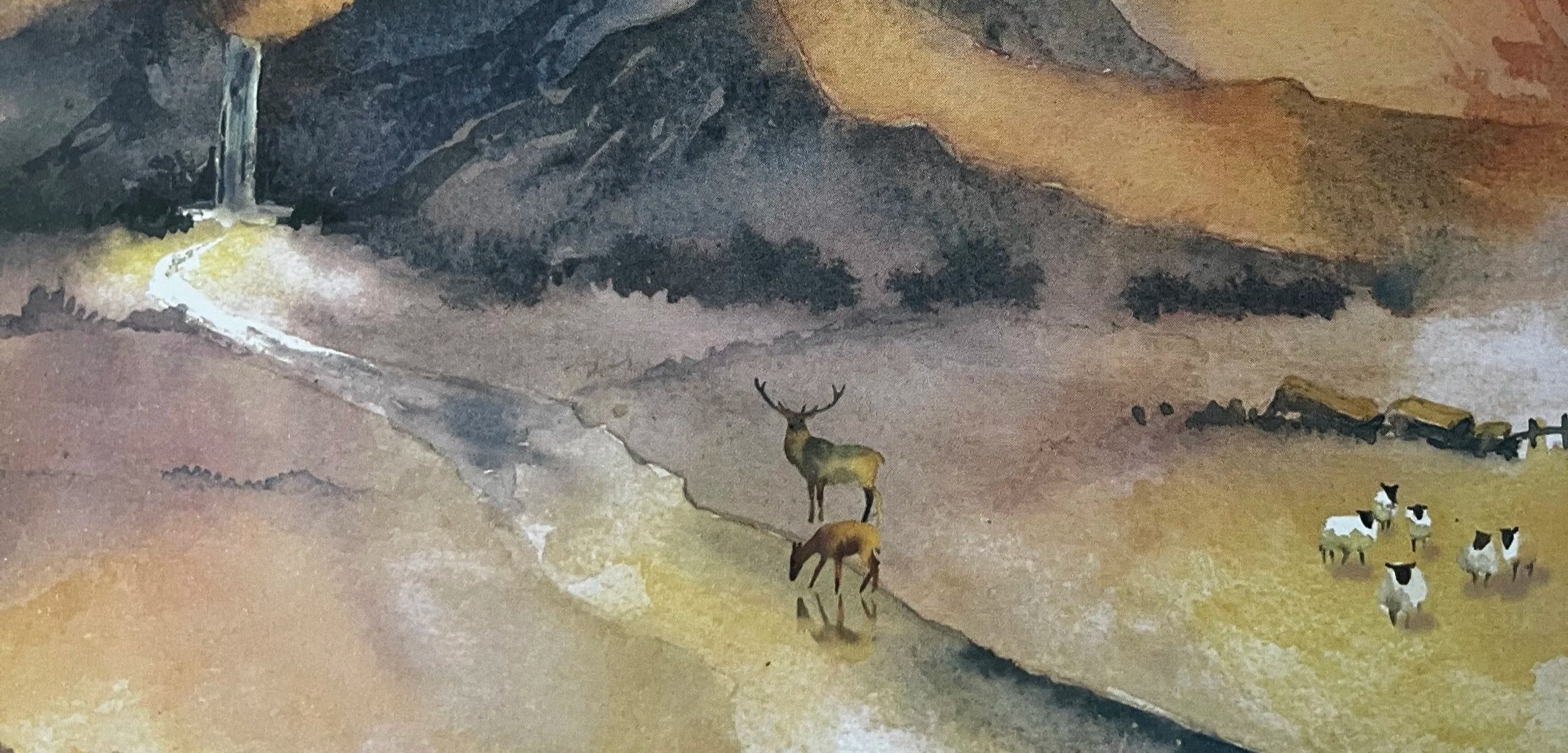
The story ends with Grace and Glory, the Good Shepherd, Joy and Peace standing together at the edge of the valley ready to leap down to the low places. As Grace and Glory looked over she saw the mighty fall cascading down and continuing lower until it reached the lowest places. Grace and Glory was filled with overwhelming joy and she followed the Good Shepherd and her companions down the mountain in the same way that the falls leapt down and sang beside them.
“From the heights we leap and flow to the valleys down below,
Sweetest urge and sweetest will, to go lower; lower still.”
Pg. 127
That was the last chapter! Thank you for joining me on this journey!
-Nadine
“There is no fear in love. But perfect love drives out fear, because fear has to do with punishment. The one who fears is not made perfect in love.” 1 John 4:18